

FabHandWear
The Problem

Hand wearables are challenging to design and fabricate because of the anatomical variability in hand forms, multiple degrees of freedom, and absence of standard manufacturing techniques. These challenges influence the accuracy and comfort of hand wearables.
The vision is to allow designers to develop hand wearables simpler and faster to enable the testing of new sensing technologies, interactions, or haptics. Easing the hand wearable creation will provide access to prototype technology quickly and accurately to multidisciplinary groups of designers with different expertise levels.
My Roll
I was the lead researcher of this project and my main tasks were:
Design
and conduct preliminary studies to evaluate the influence of wearable fitting into the interactions and elements' location on the hands
Implementation
of hand anthropometric features and degrees of freedom into the personalization of wearables
Adapt
Fabrication methodology to a digital fabrication procedure
Definition
of desing parameters and interface features for the design web interface
Analyze
Qualitative and quantitative data
Understanding the Users - Preliminary Studies
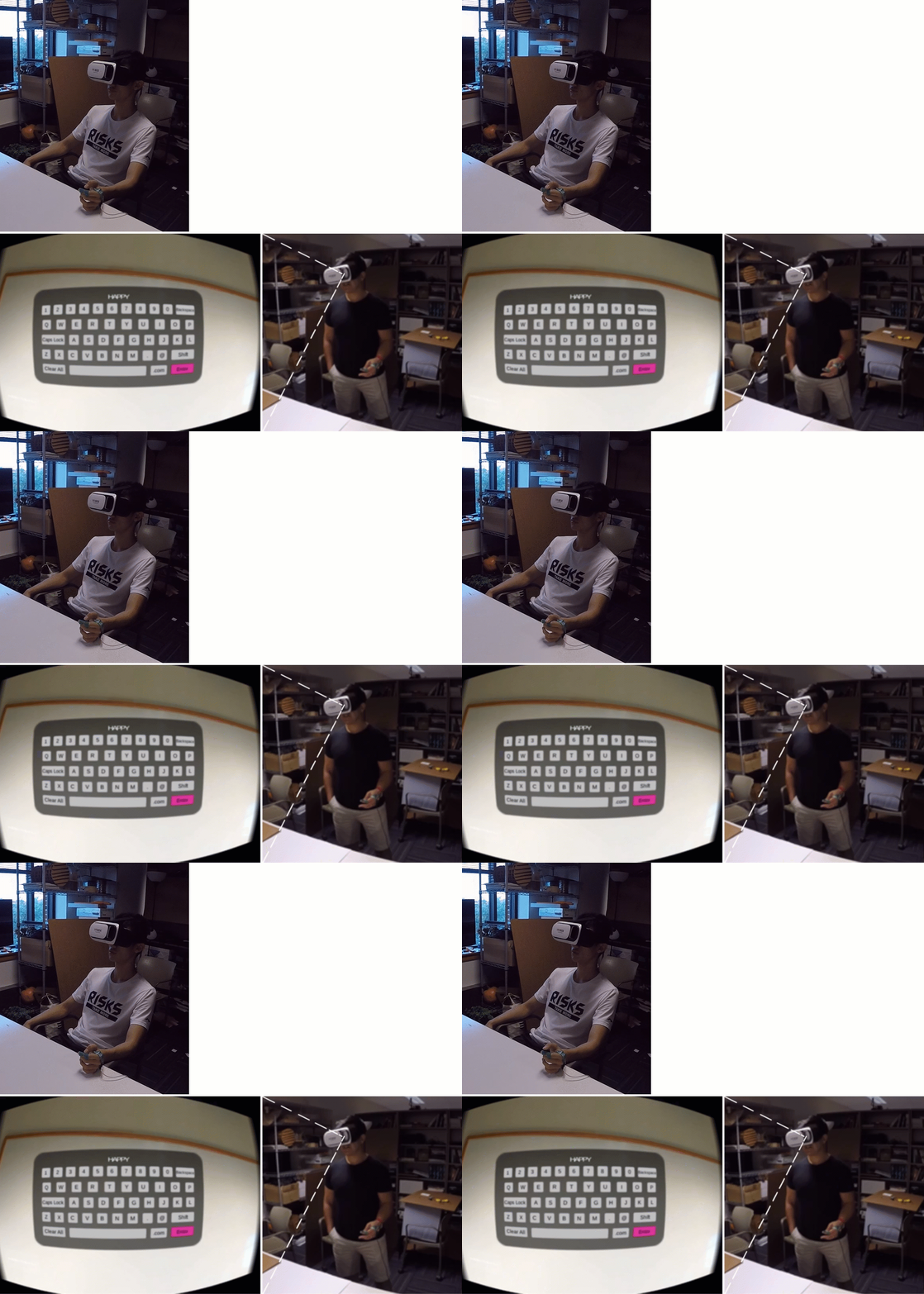
10 participants
(5 self-identified as female and 5 as male)
22-36 years old (age average = 27.3 years, SD = 4.57)
Task: navigate on a "qwerty" keyboard implemented in a head-mounted display using a textile-based hand wearable with four touch sensors on the index finger.
We wanted to analyze and understand users interacting with a wearable that is not entirely fitting on their hands.
Conventionally, developers first define the best locations to place sensing elements on the hands
before designing the wearable. This critical step showed that the ratio between the hand and the wearable have a direct effect on:
Sensor Location
The visual attention for interactions
The attachment to the hand
The location of the components on the hand
Interface

FabHandWear interface enables the design and personalization of the form and function of hand wearables. The main features of the tool are geometric and functional control, ease in circuit connections, auto-circuit generation, substrate creation, and printable pattern generation.
Example Applications

The example applications were developed to illustrate and demonstrate the feasibility and applicability of FabHandWear. The models focus on different hand features to illustrate why hands need special treatment compared to other parts of the body. Inspired by real-world, health, aesthetics, and sci-fi applications, the designs show customized hand wearables to monitor health, cosplay, or interactions with emerging technologies.
Evaluation Methodology
.png)
FabHandWear was evaluated using a desing user study. Participants had to develop 3 design tasks with the system. The goal was to evaluate the users performance with the system and how simple and faster it is compared to manual procedures.

Remote usability user study
13 participants (6F/7M)
Ages 23 to 35 years old (mean 26.23, SD 3.02)
(46.15% non-technical background)
No special knowledge of wearables, design, or engineering required
Data collection:
Video recording (screen capture) - To store process and time.
Post-survey - System Usability Scale (SUS), NASA TLX, and open questions about the design process.
The three design tasks had different different configurations, components, and hand locations to place them. Each one addressed a different hand feature, component size, number of components and application.
.png)
Lessons learned
Personalization of wearables for multiple hand features
Design time reduction - Average < 20 mins (SD = 3.8) independent of the complexity of the design.
Increased accessibility in 85% to designers with non-engineering background
Instantaneous fabrication pattern generation.

Users fitting results of one of the hand wearable customization patterns. Illustration of the differences of hand features across users with a personalized fitted design.